


The Defi Revolution is completely transforming global finance. By replacing intermediaries with blockchain technology, this movement offers unprecedented financial control, transparency, and accessibility for everyone everywhere.
This comprehensive guide explores how the Defi Revolution actively disrupts traditional banking systems. You will learn about smart contracts, decentralized exchanges, and lending protocols. Discover expert strategies, compare traditional versus decentralized systems, and understand the crucial steps to navigate this financial shift safely.
Understanding the Defi Revolution
Decentralized finance fundamentally changes how money moves. The Defi Revolution strips away the centralized authorities—like banks, brokerages, and clearinghouses—that traditionally manage financial transactions. Instead, it relies on open-source networks and cryptographic security to execute trades, loans, and asset transfers.
For decades, traditional banking maintained strict control over who could access financial products. They dictated interest rates, charged hefty fees for cross-border transactions, and imposed strict requirements for account creation. The Defi Revolution dismantles these barriers. It relies on a permissionless system. Anyone with an internet connection can access banking services without asking for permission from a centralized authority.
What Drives This Financial Shift?
Blockchain technology serves as the foundation for this systemic overhaul. When you look at the infrastructure of the Defi Revolution, you see a network of decentralized nodes validating transactions. This eliminates single points of failure. If a traditional bank’s server goes down, you lose access to your funds. If a node goes offline in a decentralized network, the system continues functioning flawlessly.
We see this resilience driving mass adoption. Users want control over their assets. They want to hold their own private keys. By utilizing a secure crypto wallet, individuals become their own banks. This shift in custody forms the bedrock of the Defi Revolution, empowering users to interact directly with financial protocols rather than relying on middlemen.
The Role of Smart Contracts
You cannot discuss the Defi Revolution without understanding smart contracts. These self-executing contracts contain the terms of the agreement directly written into lines of code. The code controls the execution, and transactions become trackable and irreversible.
Traditional lending requires credit checks, identity verification, and manual approval from loan officers. The Defi Revolution automates this entirely. If a user deposits collateral into a lending protocol, the smart contract automatically issues the loan. When the user repays the loan, the smart contract unlocks the collateral. This automation removes human error, bias, and processing delays.
Mini-Conclusion: The core architecture of decentralized finance replaces human intermediaries with mathematical certainty, ensuring that the Defi Revolution delivers faster, fairer, and more transparent financial services.
Defi Revolution vs. Traditional Banking
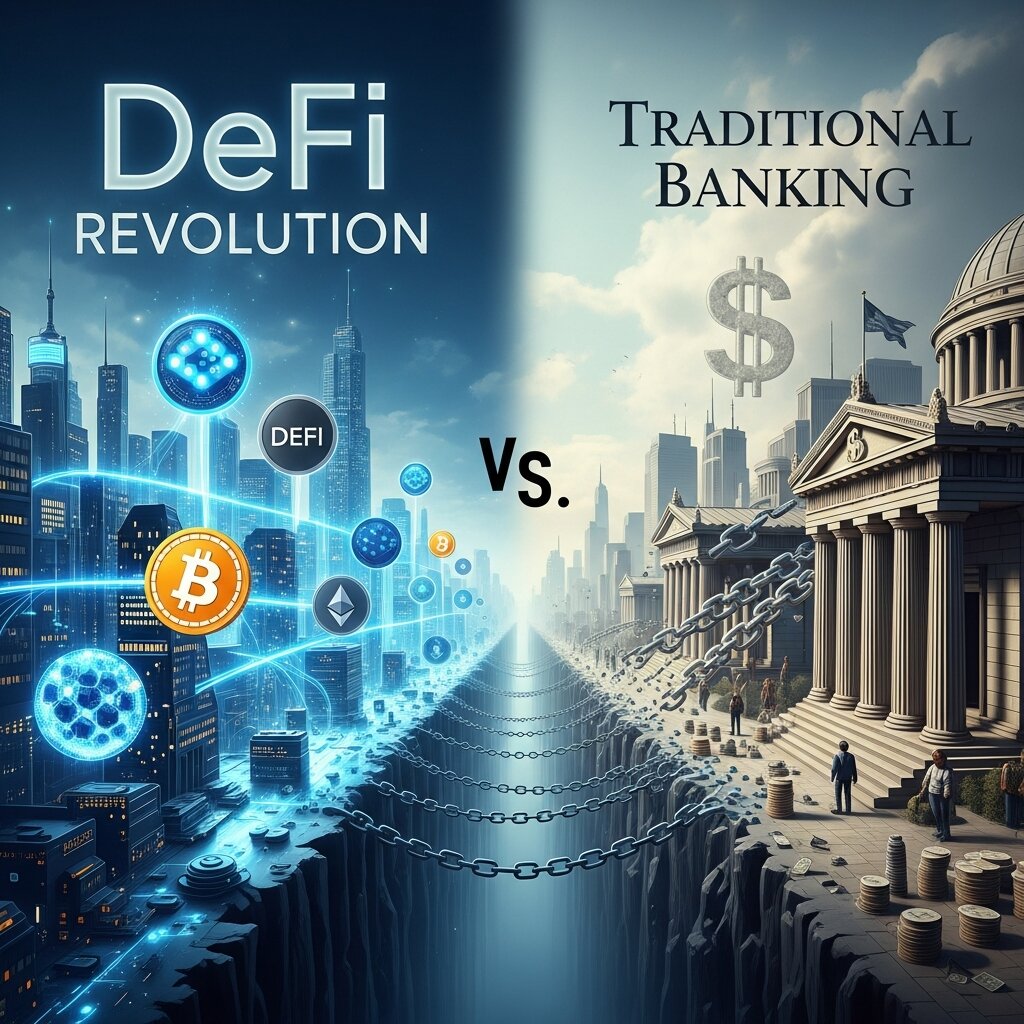
To truly grasp the magnitude of the Defi Revolution, we must compare it directly to the legacy systems we use daily. Traditional banking relies on closed ledgers. Decentralized finance uses open, public ledgers.
Speed and Global Accessibility
Traditional wire transfers take days to settle, especially across international borders. Banks rely on the SWIFT network, routing money through multiple intermediary banks, each taking a cut and delaying the process. The Defi Revolution solves this by settling global transactions in seconds or minutes.
Furthermore, traditional banking excludes billions of unbanked individuals worldwide due to lack of documentation or infrastructure. The Defi Revolution only requires a smartphone and internet access. This global accessibility champions financial inclusion on an unprecedented scale.
Cost Efficiency and Yields
Legacy banks offer minimal interest rates on savings accounts while charging high interest on credit cards and loans. The bank keeps the massive spread as profit. The Defi Revolution distributes that profit back to the users. Because decentralized platforms have no physical branches or thousands of employees to pay, they offer significantly higher yields to lenders and lower rates to borrowers.
Comparison Table: Legacy Finance vs. Decentralized Finance
|
Feature |
Traditional Banking |
The Defi Revolution |
|---|---|---|
|
Custody |
Bank holds your money |
You hold your own money |
|
Accessibility |
Requires ID, credit checks, minimum balances |
Open to anyone with an internet connection |
|
Trading Hours |
9 AM to 5 PM, Monday-Friday |
24/7/365 |
|
Transparency |
Closed ledgers, hidden operations |
Public blockchains, auditable by anyone |
|
Intermediaries |
Tellers, loan officers, brokers |
Smart contracts and code |
|
Settlement Time |
Days (for international transfers) |
Seconds to minutes |
Mini-Conclusion: The stark contrast between these two systems highlights why the Defi Revolution attracts billions of dollars in capital. Users naturally gravitate toward systems that offer better returns, faster speeds, and total ownership.
Key Components Fueling the Defi Revolution
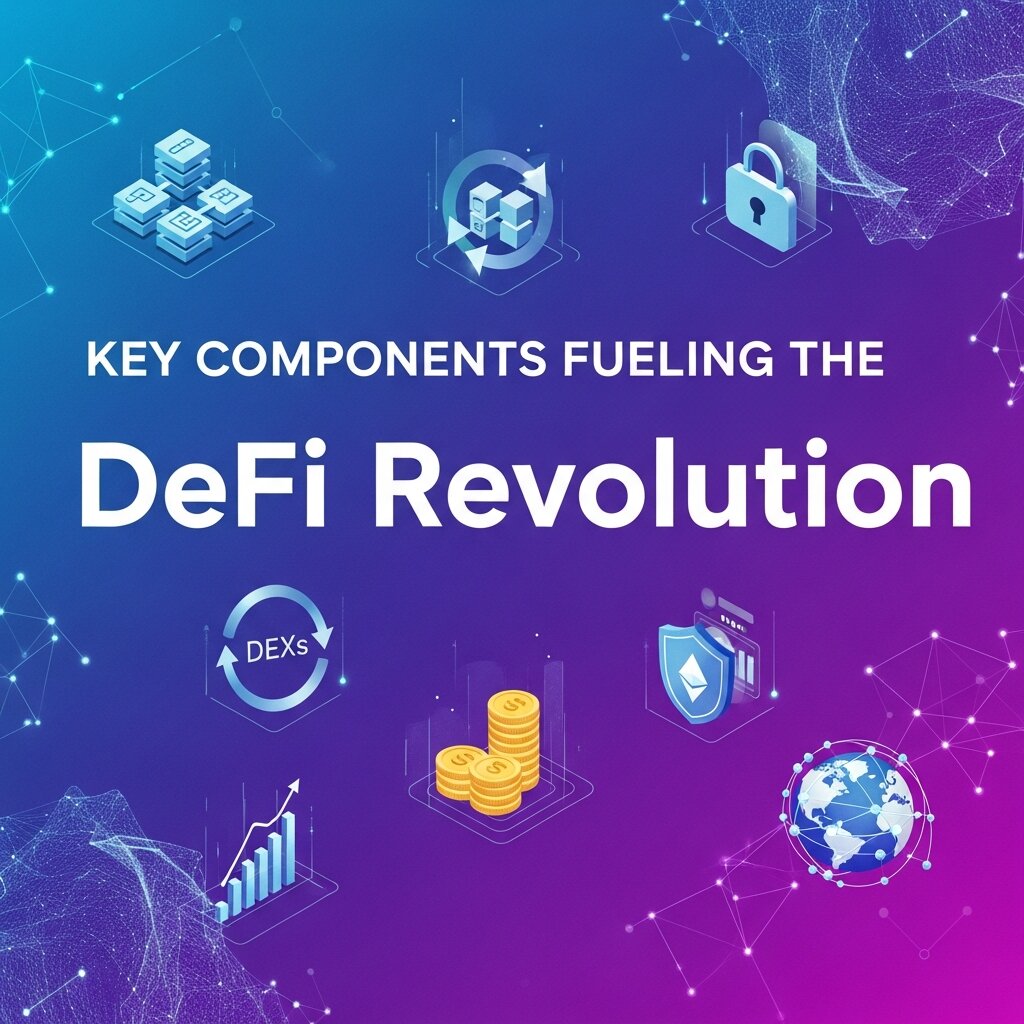
The ecosystem consists of several interconnected components that mimic and improve upon traditional financial instruments. These building blocks make the Defi Revolution a comprehensive alternative to Wall Street.
Decentralized Exchanges (DEXs)
A Decentralized Exchange allows users to trade digital assets peer-to-peer. Unlike centralized exchanges that hold user funds and facilitate trades through an internal order book, DEXs use automated market maker (AMM) protocols. Users trade directly from their wallets. This non-custodial approach perfectly aligns with the ethos of the Defi Revolution, ensuring users never surrender control of their assets to a third party.
Liquidity Pools and Yield Farming
Liquidity pools replace traditional market makers. In the Defi Revolution, users—called liquidity providers (LPs)—lock their assets into a smart contract pool to facilitate trading on a DEX. In return, they earn trading fees.
Yield farming takes this a step further. Users move their assets across different lending protocols and liquidity pools to maximize their returns. While highly lucrative, it requires a deep understanding of blockchain scalability solutions and market dynamics to avoid losses from impermanent loss and high transaction fees.
Stablecoins: The Bridge to Traditional Markets
Cryptocurrency volatility often deters everyday users from participating in digital finance. Stablecoins solve this problem. These digital assets peg their value to stable fiat currencies like the US Dollar. They serve as the lifeblood of the Defi Revolution, allowing users to earn high yields, trade, and lend without exposing themselves to wild price fluctuations.
Real-World Use Cases Transforming Finance
The Defi Revolution goes far beyond simple trading. It rebuilds the entire financial stack from the ground up.
Lending and Borrowing Protocols
Protocols like Aave and Compound dominate the lending sector of the Defi Revolution. Users deposit assets into a shared pool to earn interest. Borrowers can then take loans from these pools by providing overcollateralized assets. If a borrower’s collateral value drops below a certain threshold, the smart contract automatically liquidates it to protect the lenders. This mathematically enforced risk management eliminates the need for collection agencies and credit scores.
Synthetic Assets and Derivatives
The Defi Revolution also democratizes access to complex financial instruments. Synthetic assets track the value of real-world assets—like stocks, gold, or fiat currencies—using price oracles. This allows someone in an emerging market to gain price exposure to US equities without needing a traditional brokerage account, bypassing geographic and regulatory barriers.
Mini-Conclusion: By replicating traditional financial services with open-source protocols, the Defi Revolution creates a more equitable and efficient global economy where anyone can participate.
Common Mistakes to Avoid in Decentralized Finance
While the Defi Revolution offers incredible opportunities, it also carries substantial risks. Users must navigate this landscape carefully.
- Ignoring Smart Contract Risks: Code is law in the Defi Revolution. If a smart contract contains a bug, hackers can drain the funds. Always check if a protocol has undergone rigorous smart contract audits by reputable firms before depositing capital.
- Losing Private Keys: Because there is no customer support hotline in decentralized finance, losing your wallet’s seed phrase means permanently losing access to your funds.
- Chasing Unsustainable Yields: The Defi Revolution often features protocols offering astronomical Annual Percentage Yields (APYs). These are usually unsustainable and carry extremely high risks of collapse or “rug pulls.”
- Failing to Account for Gas Fees: Network transaction fees (gas) can spike during times of high congestion. Users making small transactions might find that the fees wipe out their potential profits.
- Overleveraging: Automated liquidations happen instantly in the Defi Revolution. Borrowing too much against volatile collateral frequently results in total loss during market downturns.
Expert Insights and Pro Tips
To succeed in the Defi Revolution, you must adopt professional security and investment practices. Here are expert strategies for navigating decentralized platforms:
- Start with Blue-Chip Protocols: Begin your journey with established platforms that hold billions in Total Value Locked (TVL) and have survived multiple market cycles.
- Use Hardware Wallets: Protect your assets from malicious software by keeping your private keys offline. A hardware wallet is non-negotiable for serious participants in the Defi Revolution.
- Track Your Portfolio Actively: Decentralized finance operates 24/7. Use specialized portfolio tracking tools to monitor your liquidity pool positions, loan health factors, and accumulated yields.
- Understand Impermanent Loss: Before providing liquidity to a DEX, deeply study how price divergence between two pooled assets can result in temporary or permanent losses compared to simply holding the assets.
- Revoke Token Approvals: When you interact with smart contracts in the Defi Revolution, you grant them permission to spend your tokens. Regularly use blockchain explorers to revoke permissions from contracts you no longer use to prevent future exploits.
The Regulatory Landscape

The rapid growth of the Defi Revolution has attracted the attention of global regulators. Governments want to prevent money laundering, protect consumers, and maintain control over monetary policy.
Balancing innovation with regulation remains the biggest challenge for the Defi Revolution. Regulators struggle to apply traditional frameworks to decentralized entities. For example, how do you regulate an exchange that has no corporate headquarters, no CEO, and runs entirely on autonomous code? The future will likely see the development of decentralized identity (DID) solutions and zero-knowledge proofs that allow users to prove compliance without sacrificing privacy.
Mini-Conclusion: While regulation will inevitably shape the future, the foundational principles of the Defi Revolution—transparency, self-custody, and open access—will continue to thrive and force traditional banking to adapt or face obsolescence.
Conclusion
The Defi Revolution permanently alters how we manage wealth, offering unmatched efficiency and transparency. Embrace this blockchain-powered future to stay ahead of traditional banking limitations. Start by exploring trusted decentralized platforms, securing your digital assets, and joining the decentralized finance movement today. Take control of your financial future now.
Frequently Asked Questions
What is the Defi Revolution?
The Defi Revolution represents a massive shift from traditional, centralized banking to open, blockchain-based financial systems. It utilizes smart contracts to automate lending, borrowing, and trading without banks or brokers.
Is the Defi Revolution safe for beginners?
While it offers significant benefits, it carries risks like smart contract bugs and market volatility. Beginners should start with small amounts, use established platforms, and thoroughly understand self-custody before committing large amounts of capital.
How do you make money in the Defi Revolution?
Users earn returns by providing liquidity to decentralized exchanges, depositing assets into lending protocols to earn interest, or participating in yield farming strategies. These methods distribute platform fees directly to the users.
Do I need a bank account to participate in the Defi Revolution?
No. You only need a digital wallet and internet access. You will, however, need a way to convert your local fiat currency into cryptocurrency, which often involves using an on-ramp service or centralized exchange initially.
How does the Defi Revolution handle customer support?
Decentralized finance relies on self-custody and autonomous code, meaning there is no centralized customer support team to recover lost passwords or reverse transactions. Users bear full responsibility for their asset security.
What happens if a smart contract is hacked?
If malicious actors exploit a vulnerability in a protocol’s code, the funds locked in that contract can be drained. This is why participating only in platforms that have undergone extensive smart contract audits is critical.
Why are transaction fees sometimes so high?
During periods of high network demand, blockchain networks can become congested. Users bid against each other to have their transactions processed faster, driving up network fees (gas). Many users utilize blockchain scalability solutions (Layer 2 networks) to bypass these costs.
Can the Defi Revolution completely replace traditional banks?
While it currently serves as a parallel financial system, it forces traditional banks to innovate. Eventually, we will likely see a hybrid model where legacy institutions integrate decentralized protocols to improve their backend settlement processes.
What are stablecoins and why are they important?
Stablecoins are cryptocurrencies designed to maintain a 1:1 value with fiat currencies like the US Dollar. They provide stability within the volatile crypto market, allowing users to lend and trade without worrying about sudden price crashes.
How do decentralized exchanges (DEXs) set asset prices?
Unlike traditional stock markets that use order books, DEXs use Automated Market Makers (AMMs). AMMs use mathematical formulas to price assets based on the ratio of tokens held within the liquidity pool, ensuring continuous liquidity.
