



Crypto markets swing fast, and 2026 is no different. This guide breaks down the top crypto volatility strategies every investor should understand before putting money to work. You will learn how to manage risk, time entries, and stay calm when prices move sharply in either direction.
This article explains what volatility is, why crypto moves so sharply, and how to respond with discipline. You will explore dollar-cost averaging, swing trading, breakout trading, portfolio rebalancing, laddered entries, stablecoins rotation, and volatility hedging. We add comparison tables, scenario frameworks for bull, bear, and sideways markets, plus common mistakes to avoid. This is educational content, not financial advice.
What Crypto Volatility Really Means
Before chasing any tactic, you need to understand what you are working with. Volatility is simply a measure of how much an asset’s price moves up or down over a period of time. The bigger and faster those swings, the more volatile the asset.
According to Coinbase, volatility is one of the primary factors used to assess investment risk. A highly volatile asset can deliver larger gains, but it can also produce steeper losses over short windows. That two-sided nature is the heart of every approach we will cover.
Crypto sits at the high end of the volatility scale. It is a young asset class, barely more than a decade old, and it reacts strongly to news, sentiment shifts, and trading volume changes. Bitcoin can move by double digits in a single week, while smaller tokens swing even harder.
This matters because your strategy should match the asset’s behavior. You cannot treat a memecoin like a blue-chip stock. Understanding volatility helps you size positions, set expectations, and avoid panic when the chart turns red.
How volatility is measured
Analysts usually talk about two types. Historical volatility looks backward, measuring how prices moved over a set window like 30 days or a year. Implied volatility looks forward, estimating expected future swings. Tools like standard deviation help quantify how far prices stray from their average, giving you a clearer read on risk.
Why Crypto Is So Volatile

Knowing the causes of volatility helps you predict when storms might hit. Several forces push crypto prices around more than traditional assets, and each one offers a clue about how to prepare.
First, the market is still maturing. Lower overall liquidity compared to stocks or bonds means large trades can move prices sharply. Thin order books amplify swings, especially for smaller coins with low trading volume.
Second, news and market sentiment drive rapid reactions. A single regulatory headline, exchange update, or high-profile endorsement can spark double-digit moves within hours. Crypto trades 24/7, so there is no closing bell to pause the action and let emotions cool.
Third, leverage magnifies everything. Many traders use borrowed funds, and when prices move against crowded positions, forced liquidations cascade. This can turn a modest dip into a sharp crash, then a sudden bounce.
That said, volatility is not all bad. For some investors, it is the appeal, since large swings create opportunities for gains. Coinbase notes that higher trading volumes and growing institutional participation appear to be reducing Bitcoin’s volatility over time, even if it remains elevated.
The role of asset type
Not all crypto behaves the same. Established coins like Bitcoin and Ether tend to be less volatile than newer DeFi tokens or speculative altcoins. When you experiment with higher-risk assets, the old rule applies: only commit amounts you can afford to lose.
How to Assess Volatility Before You Invest
Smart investing starts with measurement, not guesswork. Before deploying capital, take time to gauge how wild an asset’s price action has been and how it might behave next.
Start by reviewing historical price charts over multiple timeframes. A coin that regularly swings 20% in a week demands tighter risk controls than one that drifts a few percent. Look at how it behaved during past market stress, since those moments reveal true downside potential.
Next, pay attention to volatility indicators. Implied volatility, the kind that powers products like the CME Group Bitcoin Volatility futures, reflects the market’s expectation of 30-day price swings. CME Group notes these contracts let participants express a view on expected volatility independent of Bitcoin’s direction, which signals how seriously institutions treat volatility as its own variable.
Finally, factor in liquidity and volume. High volume usually supports steadier pricing, while very low volume often precedes erratic moves. Combining these checks gives you a realistic picture before any money changes hands.
Building a personal risk profile
Assessment is only useful if it connects to you. Ask how much loss you can tolerate without panic selling, how long you plan to hold, and how a sharp drawdown would affect your goals. Your answers shape which of the strategies below fit your situation best.
Top Crypto Volatility Strategies for Long-Term Investors
Long-term investors and active traders need different playbooks. This section focuses on approaches built for patience, discipline, and reduced stress, ideal for those who believe in crypto’s long arc but want to smooth the ride.
The most accessible of all volatility strategies is dollar-cost averaging. Instead of trying to time the perfect entry, you invest a fixed amount at regular intervals regardless of price. Coinbase explains that this approach can reduce the impact of market volatility, since you buy more units when prices fall and fewer when they rise, lowering your average cost over time.
DCA works because it removes emotion. You stop agonizing over whether today is the bottom and simply follow a plan. For beginners and busy investors, it is one of the most reliable ways to build exposure without obsessing over charts.
A second pillar is portfolio rebalancing. As prices move, your allocations drift. A coin that doubles may grow from 20% of your portfolio to 35%, raising your risk. Rebalancing trims winners and adds to laggards, keeping your risk level steady and locking in some gains along the way.
Third, consider strategic use of stablecoins. These tokens are pegged to a reserve asset like the U.S. dollar and are designed for low volatility. Holding a portion of your portfolio in stablecoins gives you dry powder to deploy during dips and a calmer place to park value when markets feel overheated.
Combining patient strategies
These approaches stack well together. You might use DCA to build a core position, rebalance quarterly to control risk, and keep a stablecoin reserve for opportunistic buying. This blend offers structure, reduces emotional decisions, and suits investors who prefer a steady hand over constant trading.
Active Trading Strategies for Volatile Markets
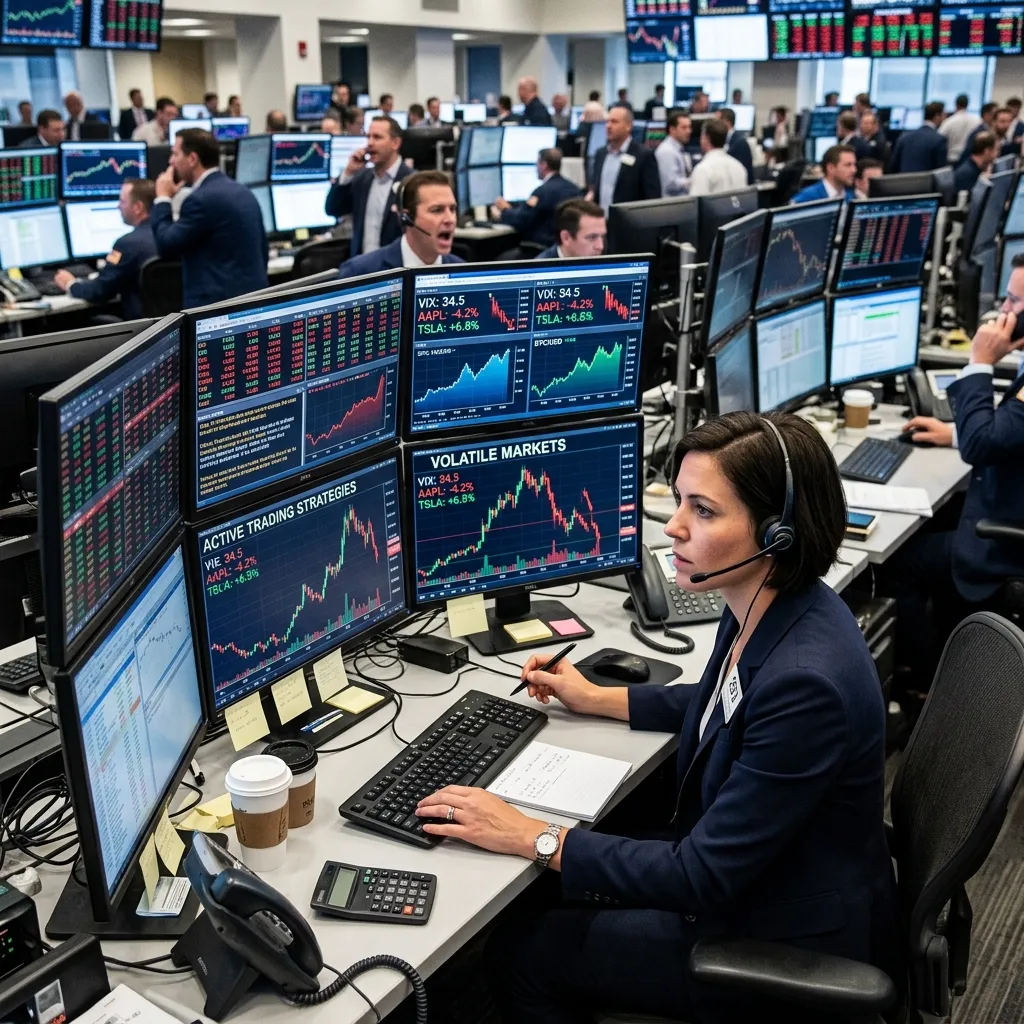
For those willing to watch charts closely, volatility creates frequent opportunities. These tactics demand more time, skill, and emotional control, so they suit experienced participants rather than casual investors.
Swing trading aims to capture price moves over days or weeks. Traders identify a likely range or trend, enter near support, and exit near resistance. It relies on reading momentum and market sentiment rather than predicting long-term value. The goal is to profit from the medium-term swings that define crypto.
Breakout trading focuses on moments when price pushes past a defined level of support or resistance. A clean breakout above resistance, backed by strong volume, can signal the start of a sharp move. Traders enter as the level breaks and place protective orders in case the breakout fails, which it often does.
Buying the dip is another popular response to volatility. When a strong asset drops sharply on fear rather than fundamentals, some investors add to positions at lower prices. The challenge is distinguishing a healthy pullback from the start of a deeper decline, which requires discipline and a clear plan.
Laddered entries and exits
Rather than committing all capital at once, laddering spreads orders across multiple price levels. On the way in, you place staggered buy orders so you accumulate gradually as prices fall. On the way out, you set tiered sell targets to scale out of winners. This reduces the pressure of nailing a single perfect price and helps you act methodically when emotions run high.
Risk Management and Volatility Hedging
No strategy survives without protection. The difference between investors who last and those who get wiped out usually comes down to disciplined risk management, not flashy entries.
Start with position sizing. Never risk more on a single trade or asset than you can afford to lose. A common guideline is to limit any one position to a small percentage of your total portfolio, so a sharp drop in one coin cannot sink everything. Sizing is your first and strongest line of defense.
Next, build a clear stop-loss strategy. A stop-loss is a predetermined price at which you exit to cap losses. Setting it before you enter removes emotion from the decision. Trailing stops can lock in gains as prices rise while still protecting your downside if the trend reverses.
More advanced participants explore volatility hedging. CME Group’s Bitcoin Volatility futures, for example, let market participants trade on the magnitude of expected price swings independent of direction. This means an investor can hedge against turbulence itself, adding a layer of protection during uncertain periods. These instruments are sophisticated and carry their own risks, so they suit informed traders only.
Diversification rounds out the picture. Spreading capital across different assets, and even pairing volatile crypto with lower-volatility holdings, reduces the chance that a single shock devastates your portfolio. The principle is old, but it remains one of the most effective ways to manage risk.
Setting rules before you trade
Write your rules down before emotions take over. Decide your maximum loss per trade, your total crypto allocation, and the conditions that would make you exit. When the market moves fast, a written plan keeps you anchored while others react in panic.
Comparing the Top Strategies at a Glance
Each approach carries a different mix of effort, risk, and reward. The table below summarizes how they stack up, helping you match a strategy to your goals, experience, and available time.
|
Strategy |
Best For |
Effort Level |
Risk Level |
Time Horizon |
|---|---|---|---|---|
|
Dollar-cost averaging |
Beginners, long-term investors |
Low |
Lower |
Long term |
|
Portfolio rebalancing |
Disciplined investors |
Low to medium |
Lower |
Ongoing |
|
Stablecoin rotation |
Cautious investors |
Medium |
Lower |
Flexible |
|
Swing trading |
Experienced traders |
High |
Higher |
Days to weeks |
|
Breakout trading |
Active, skilled traders |
High |
High |
Short term |
|
Laddered entries/exits |
Methodical investors |
Medium |
Medium |
Flexible |
|
Volatility hedging |
Advanced participants |
High |
Variable |
Short to medium |
Use this as a starting filter, not a rulebook. Many investors blend several approaches, for example pairing DCA for a core holding with occasional swing trades using a small, separate portion of capital.
Scenario-Based Frameworks for Different Markets

Strategies should adapt to conditions. What works in a roaring bull market can backfire in a downturn. Here is how to think through three common environments, each demanding a different mindset.
In a bull market, momentum runs strong and prices climb. This is the time to consider scaling out gradually with laddered exits, taking partial profits as targets hit. Rebalancing becomes especially valuable, since outsized winners can quietly inflate your risk. Resist the urge to chase every pump.
In a bear market, fear dominates and prices fall. Patient strategies shine here. Continuing dollar-cost averaging lets you accumulate at lower prices if you believe in the long-term thesis. Many investors rotate more heavily into stablecoins to preserve capital and stay ready to buy when sentiment finally turns.
In a sideways market, prices chop within a range without clear direction. This environment can frustrate trend followers but reward range-based swing trading, where traders buy near support and sell near resistance. Tight risk control matters most here, since false breakouts are common and can trap the impatient.
Reading the shift
Markets rarely announce a regime change. Watch volume, market sentiment, and how price reacts at key levels. When conditions shift, adjust your tactics deliberately rather than clinging to a strategy that no longer fits. Flexibility, paired with discipline, separates seasoned investors from the crowd.
Common Mistakes to Avoid
Even good strategies fail when paired with poor habits. Steering clear of these pitfalls protects both your capital and your confidence.
Trying to time the perfect top or bottom is a classic trap. Even professionals rarely manage it. This is exactly why dollar-cost averaging exists, since it removes the pressure of perfect timing entirely.
Over-leveraging is one of the fastest ways to lose everything. Borrowed funds amplify gains, but they magnify losses just as harshly, and forced liquidations can wipe out a position in minutes. Use leverage cautiously, if at all.
Skipping a stop-loss strategy leaves you exposed to catastrophic drawdowns. Hoping a falling asset will recover often turns a manageable loss into a devastating one. Set your exit before you enter.
Letting emotion drive decisions undermines every plan. Panic selling at the bottom and greedy buying at the top destroy returns. A written framework and steady risk management keep you grounded when markets test your nerves.
Finally, ignoring position sizing and chasing hype coins without research invites disaster. Concentrating too much capital in one speculative bet means a single bad move can derail your entire portfolio.
Expert Insights and Pro Tips
Seasoned investors share consistent wisdom worth absorbing. These tips help you apply the strategies above with greater confidence and fewer regrets.
First, automate where you can. Setting up recurring buys for dollar-cost averaging enforces discipline and removes the temptation to skip contributions when fear strikes. Consistency beats cleverness over the long run.
Second, keep a cash or stablecoin buffer. Holding dry powder lets you act on genuine opportunities during sharp dips instead of scrambling or selling other holdings at bad prices. Portfolio rebalancing naturally creates these moments.
Third, treat trading capital separately from long-term holdings. Many experienced participants keep a core portfolio they rarely touch and a smaller, clearly defined pool for swing trading or breakout trading. This protects your foundation from speculative mistakes.
Fourth, track your decisions in a journal. Recording why you entered and exited each position reveals patterns in your behavior. Over time, this feedback loop sharpens your judgment far more than any single tactic.
Fifth, never stop learning about volatility hedging and new tools. As regulated products like volatility futures expand, informed investors gain more ways to manage turbulence. Stay curious, but only use instruments you genuinely understand.
Conclusion
Volatility is the price of admission in crypto, but it does not have to control you. The top crypto volatility strategies, from dollar-cost averaging and rebalancing to disciplined risk management and hedging, give you tools to invest with confidence in any market. Start small, stay disciplined, and keep learning. Explore these approaches today and build a plan that fits your goals. This article is educational, not financial advice.
Frequently Asked Questions
1. What are the best crypto volatility strategies for beginners?
For beginners, the safest starting point is dollar-cost averaging, which Coinbase notes can reduce the impact of market volatility by investing fixed amounts at regular intervals. Pair it with strong position sizing and a stablecoin reserve. These low-effort approaches build exposure gradually while removing the stress of perfect timing, making them ideal for those new to volatile crypto markets.
2. What does crypto volatility actually mean?
Volatility measures how much an asset’s price moves up or down over time. According to Coinbase, the more volatile an asset, the riskier it is considered, with greater potential for both gains and losses over short periods. Crypto is highly volatile because it is a young asset class that reacts strongly to news, sentiment, leverage, and shifts in trading volume.
3. Is dollar-cost averaging better than trying to time the market?
For most investors, yes. Timing the market is extremely difficult, even for professionals. Dollar-cost averaging sidesteps this by spreading purchases over time, so you buy more when prices are low and less when they are high. This lowers your average cost and removes emotional decision-making, though it does not guarantee a profit or protect fully against loss.
4. How can I protect my portfolio during a crypto crash?
Use layered risk management. Set a clear stop-loss strategy, keep individual positions small through disciplined position sizing, and hold a portion in stablecoins to preserve value. Diversification helps too. Advanced investors may explore volatility hedging with regulated products. The key is having written rules in place before a crash hits, so emotion does not drive your decisions.
5. What is the difference between swing trading and breakout trading?
Swing trading captures price moves over days or weeks, often buying near support and selling near resistance within a range or trend. Breakout trading focuses on moments when price pushes past a key support or resistance level, ideally on strong volume. Swing trading suits range-bound markets, while breakouts target the start of sharp directional moves. Both demand experience and tight risk control.
6. Are stablecoins a good way to manage volatility?
Stablecoins can help. They are pegged to a reserve asset like the U.S. dollar and designed for low volatility, giving you a calmer place to park value during turbulent periods. Holding stablecoins also provides dry powder to buy dips. However, they carry their own risks, including peg stability and issuer concerns, so research any stablecoin before relying on it heavily.
7. What is volatility hedging in crypto?
Volatility hedging means protecting against the size of price swings rather than their direction. CME Group’s Bitcoin Volatility futures, for example, let market participants express a view on expected 30-day implied volatility independent of Bitcoin’s price direction. This lets sophisticated investors hedge turbulence itself. These instruments are complex and risky, so they suit informed, experienced traders rather than beginners.
8. How do I know if an asset is too volatile for me?
Compare the asset’s price swings against your personal risk tolerance. Review historical charts across timeframes and note how it behaved during past market stress. If a 20% weekly drop would push you to panic sell or harm your financial goals, the asset is likely too volatile for your current allocation. Adjust position sizing or choose steadier assets accordingly.
9. Should my strategy change in bull versus bear markets?
Yes. In bull markets, consider laddered exits and portfolio rebalancing to lock in gains and control risk. In bear markets, patient approaches like dollar-cost averaging and rotating into stablecoins help you accumulate and preserve capital. In sideways markets, range-based swing trading with tight stops can work. Adapt deliberately as conditions shift rather than clinging to one fixed approach.
10. Can I combine multiple crypto volatility strategies?
Absolutely, and many experienced investors do. A common blend uses dollar-cost averaging for a core long-term position, periodic portfolio rebalancing to manage risk, and a small, separate pool for swing trading or breakout trading. Keeping trading capital distinct from foundational holdings protects your base. Just ensure each strategy fits your goals, time, and experience level before combining them.
